
NO ESCAPE/ WITHOUT A VOICE
Dedicated to my sister, Maureen

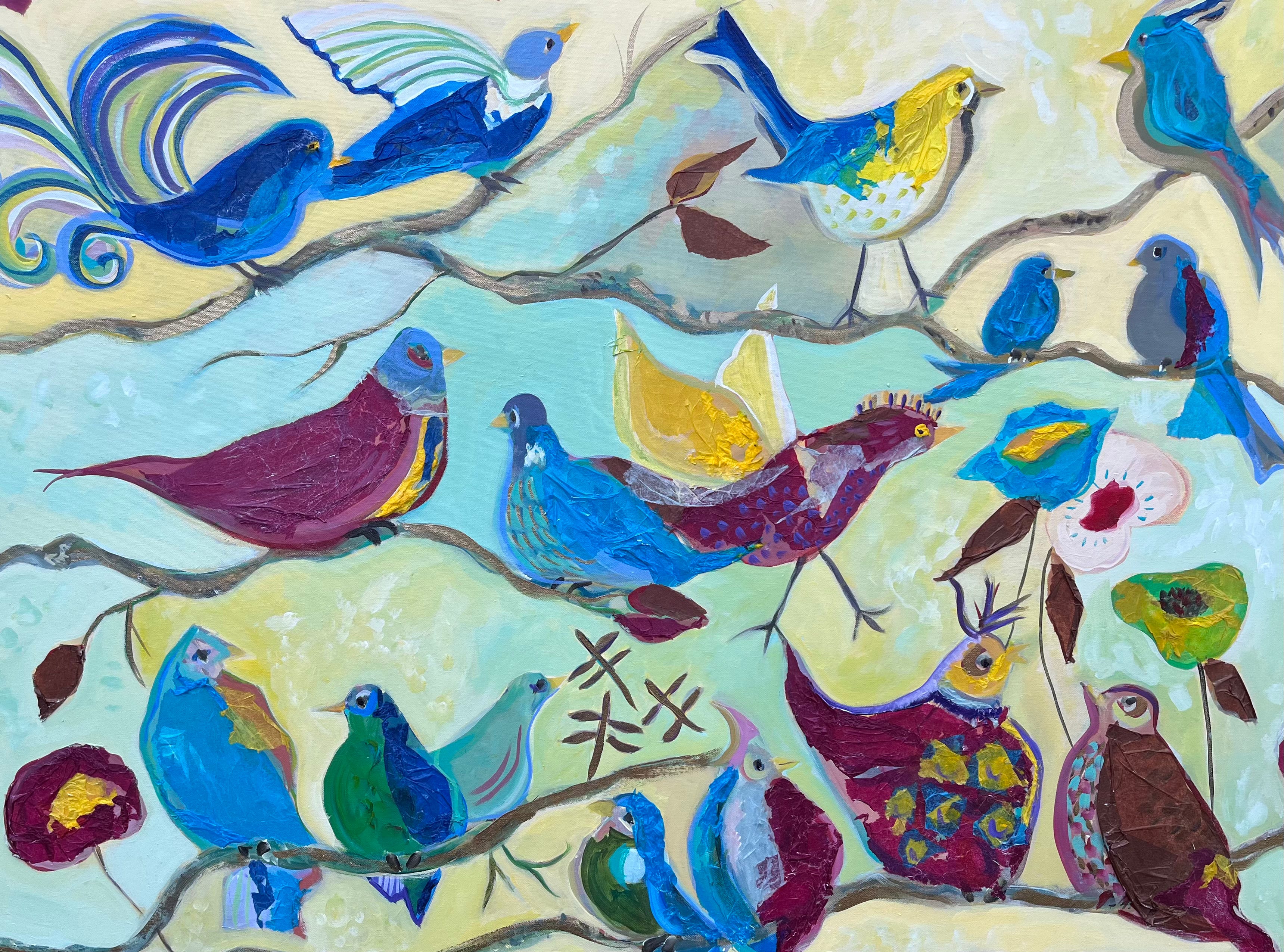
BIRDS-Acrylic on Canvas- Michele Maggiora
A Voice, the Melody of Birds…to my sister
A voice is precious. Without a voice, my power lost. Without empowerment, this absence of voice, the birds don’t sing, women have no rights, children are vulnerable, workers struggle under the thumb of the oligarch.
A voice is precious. Without a voice, my power lost. Without empowerment, this absence of voice, the birds don’t sing, justice loss, violence in the global narrative strengthens, systemic forms of loss, denial, and inequality, tumors that cannot be extracted.
Give me a voice, inflame all that is hidden, all that is lost to taboo and lies. I will yell out my sadness, my grief, and my rage. It is fear that denies my voice, shrinks from the possibility of freedom.
I sprinkle lovely seed she gives me and hear the birds begin to sing. Give me a voice, give us all a voice, and listen to the birds sing.
*****************************
“What do we call the millennia of disappearances of women from the public sphere, from genealogy, from legal standing, from voice, from life?” Rebecca Solnit
“A voice is a human gift; it should be cherished and used, to utter fully human speech as possible. Powerlessness and silence go together.” Margaret Atwood
I see her sitting, looking out the window, gazing into what she could not recognize. Feelings changing in her body, blood coming, fantasies of hearts and flowers covering up enslavement, a young woman who would be passed from father to husband. Approaching that age when women were expected to marry, a repugnance grew inside her. No one could see it, and in her silence she could not articulate it, otherwise she would have screamed, “They give me tools to barely survive in the male dominant world, but never tools designed for my escape.”
My partner’s mother was born in the Upper Midwest to parents who came from Northern Europe at the turn of the last century. Their culture’s design for women—crammed with customs, rules and rituals overwhelmingly cruel to women—substantiates what was believed to be women’s nature.
All she wanted was to play music and nurture her talent. The perfect pitch singing in her ears craved notes with melodies to fill her.
There was no mentor to help extract this dis-ease from what would become of her, no one to guide her. No one who understood, let alone could escort her from this condemnation. She married and had children, the noose tightening around her neck, suffocating her. The unconscious struggle destroyed her equilibrium, so she acted out. Her voice would change, turn gravelly, and cleaning orders to her children followed. Urgent for order, fanatic to allay her silent chaos, she forced her small children to endlessly scrub the house, from top to bottom. Was she trying to wash away a turbulent storm present within her?
No one, no options, no escape, no voice.
Women in Madness, a book written over seventy years ago by Phyllis Chesler, continued to be relevant for decades. In it she points out that not that long ago, women who refused marriage and children could be committed to a mental institution. Only madness, it was believed, could divert a woman from what was believed to be her nature—to be a wife and mother. In the mid-twentieth century, the all-male supreme court judges hearing Ruth Bader Ginsburg’s first case glibly declared in all seriousness that it’s a woman’s nature to nurture, confirming madness to follow any other path.
But it was turning away from her true nature and being trapped by culture’s demands that were her madness. She went crazy, not inside an institution but from beliefs pushing her into marriage and motherhood as she felt the walls of those demands crushing in on her heart and soul.
I feel empathy for souls without escape. I am saddened by the cultural rules and beliefs about women and our natures, evident in her generation, still present in mine, and in ways continuing to seep into the present; anywhere where women and girls are without a voice. Certainly there have been advances, availabilities for women today, however just look around. Look at the military, certain churches, the casting couch, deep rooted traditions here and abroad carrying limitations, no matter how subtle.
Children who live in a family in which their mother has no voice experience how lack of voice brings detrimental effects. Repercussions of her rage and frustration lay the foundation of their childhood trauma, scars carried into adulthood, that obliterated the important foundation of love and protection.
Unlike my partner’s mother, I was fortunate to be predominantly fostered by my older sister. My mom was there but my sister was the legitimate force in my life. She held back the walls of culture, celebrated my precociousness, assured me of my personal power long enough for me to find my voice. She read to me throughout childhood and later shared insights from the mountains of her books. They posed profound questions, giving birth to my inquiry and enlightening my imagination.
An important book was Steppenwolf, by Herman Hesse; she identified with the main character, a brilliant loner. She, like the Steppenwolf, had sight of the immortals but was unable to act on what she saw. In me, she described a readiness, calling me an apprentice who sees and has the capacity to act. It was a revelation; I was only in my late teens.
From another book by Hesse, somewhat of a cautionary tale, Damian’s story illuminates how uniqueness is treated and feared by the status quo. The original Bible story of the two brothers, Cain and Abel, presented as good and evil, involved the first murder, which was pinned on Cain. Hesse’s interpretation discloses how those urgent to maintain the status quo hated Cain for his ability to transform life and threaten their power over the masses, by killing his voice.
My sister’s and my paths were dissimilar yet spun from the same flax, interwoven into the same tapestry, sometimes allowing us to envision ourselves on that seesaw of Bergman’s film, Wild Strawberries—me in white and her in black. It was not angel versus devil, nor a moralism of good and evil on that seesaw; instead, my sister and I debated the meaning of life and death. I always pushed for life. She cut herself. At eight, I saw scars on the knuckles of her hands. I was afraid one day she would die by suicide. Later, I understood this self-scarring was a scream for help. She would explode, then crumble in the corner and become calm. Later she told me of the necessity of this explosion.
“But I’m happy you got calm,” I told her. “No, you don’t understand. I had to explode.” “But why?” I asked. “It scares me!” “I’m not trying to scare you but when I feel like a pressure cooker, I need to explode.”
I shook my head. “But don’t you know when it’s escalating?” “I get past a certain point, and I cannot stop it. I kind of fall over a brink or cross a line.”
I understand today that if she did not explode, it may have killed her. The explosion was her voice.
My sister and I were symbols of light and shadow, overwhelming and necessary.
Caught by the ‘external’ voices of guilt and regret, sometimes brought deep conversation. “The seed needs to go into the dark,” she’d tell me. “To get nourished, because there’s a richness there, that’s where it finds its voice. The darkness is not evil.” We both understood the concept of evil as bound to a duality of God and Devil, or good and evil. We rejected this duality
“The cycle continues: into the light, into the dark, into the light. And later, again the seed will descend into the darkness.” We understood the cycle of light and dark, the yin and yang as opposites but absolutely connected as one, an understanding of the necessity of voice.
My partner’s mother had no voice, and this expressed itself in her compulsive madness.
My sister had a voice, but it was trapped. Like Herman Hesse’s Steppenwolf, she could see but could not act on what she saw. It became dynamite exploding in a tin can. My sister held the space for the emergence of my voice and nurtured my ability to use it.
¿Qué condiciones, circunstancias, personas e incluso accidentes propician que nuestras nuestras voces surjan, emerjan de nuestro ser y salgan a convivir al mundo?
¿De qué maneras somos múltiples maneras somos capaces de expresar el universo emocional e intelectual que nos conforma, los asombros y las dudas con las que convivimos día a día?
¿Cuáles han sido y siguen siendo los efectos de silenciar nuestras formas de expresión?
¿Qué procesos cognitivos y socio-emocionales se truncan al imponer el silencio?
¿Qué ha determinado que unos gocen del pleno derecho de expresarse en tanto que para otras personas se niega ese mismo derecho?
Michele, estas y muchas otras inquietudes detona en mí el relevante que tema que abordas en No escape/ Whithout a voice. Podría parecer un asunto "sencillo" pero de ninguna manera lo es, sin duda conforma uno de los rasgos determinantes de nuestra humanidad que aún seguimos negando a tantxs. Y claro sus efectos saltan a la vista, pero no queremos hacernos cargo.
Gracias por tus reflexiones compartidas.