
DANCING ON THE BEACH

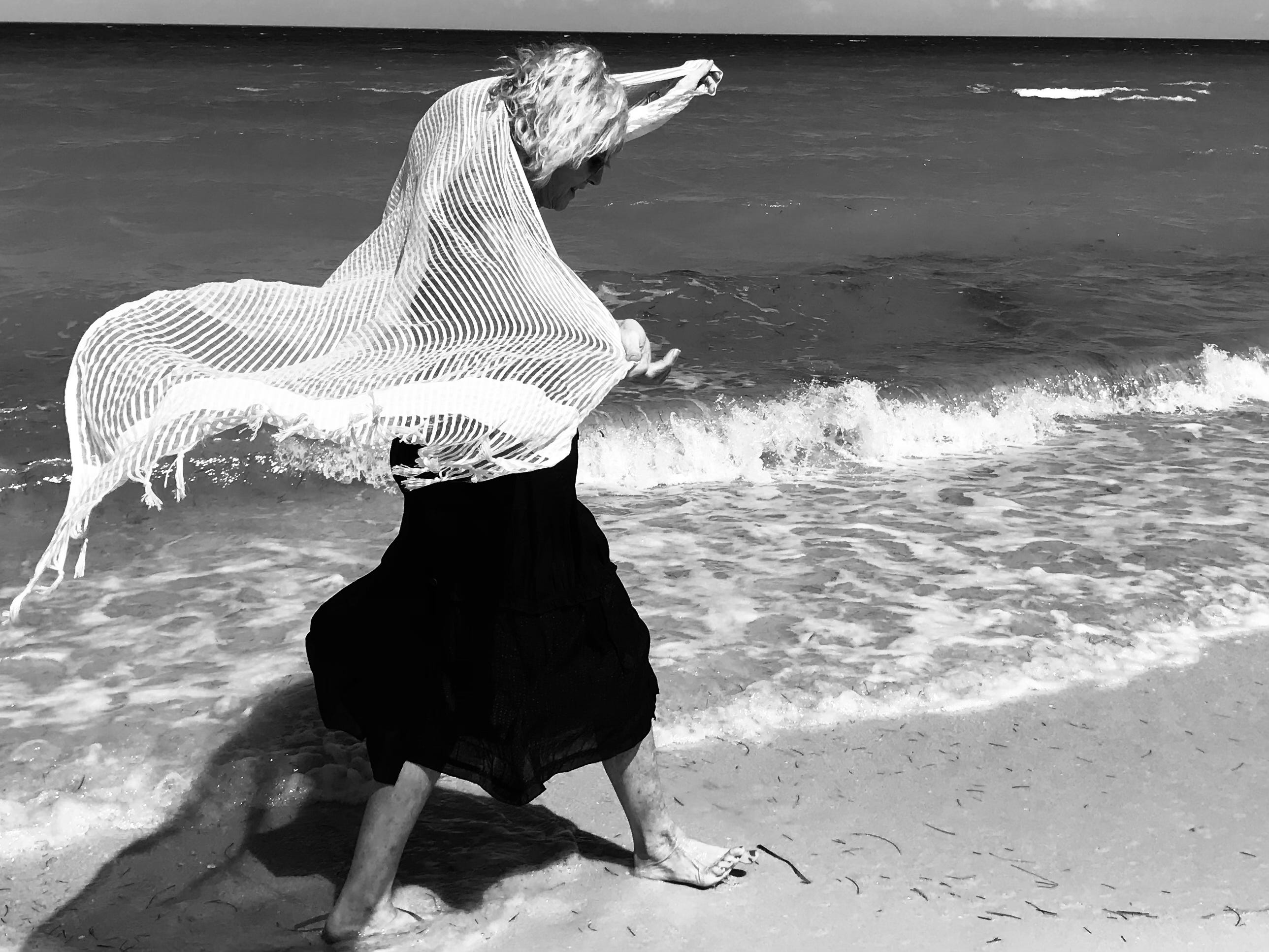
Every sunset, I watch a heavy-set old woman wearing a bright blue dress make pirouettes across the stones, a ritual to the sea or to her family that discarded her there. The swelling waves of the Mediterranean dance with her and seagulls watch, wondering at her abandon, her freedom.
I never met her, but I did meet another woman named Eldre. She stood on her balcony, practically adjoining mine, her eyes, brilliant green, her hair wrapped in a faded turban. She called out to me, “You are either an artist or a dancer.” I loved that she envisioned me that way; and our friendship began.
Every day, Eldre carried her small battery powered phonograph with records of classical music to the beach. She and I sat and sometimes I danced, imitating the pirouettes of the lady in blue. Eldre shared the details of her life, that she was Swedish, was the youngest of five sisters, all musicians who gathered every night near the hearth with violin, cello and flute. The Swedish artist Munch often visited to lift his spirits, soaking in the melodies of the daughters. He recounted narratives of plays, his favorite, Hedda Gabbler of Henrik Ibsen about a woman who chose the tragedy of suicide to escape a life of inferiority and subjugation. Eldre immediately identified with this catastrophe.
One day, an Estonian diplomat to Moscow visited. Mr. Erbeck was seeking a wife. Eldre’s father gave him her hand; she was sacrificed, given to Mr. Orbeck and taken to Moscow, another subjugated female.
“I hated it there”, she confessed to me. “All the other wives, upholding the demands for ‘proper’ behavior for a wife of a diplomat, were withered and old. I was young and at the banquets given for dignitaries, I yearned to dance but it was forbidden. Eldre would wake up very early and escape to the city center, going to the marketplace in a plain dress so she would not be discovered, her form of rebellion.
In 1940, the Soviet Union, decided to annex the Balkan states; posters declaring immediate imprisonment for Balkan diplomats, her husband instructed her to leave with his parents. Their elegant home in Moscow was boarded up, and Mr. Orbeck went into hiding. With a few valises, she and her in-laws waited in the cold to be taken to the ship for Berlin. The ship was infested with rats, inedible provisions and an immense sense of fear and loss she felt, as did others. Once in Berlin, they were taken to eat, after which they threw up from the richness of the food.
I had rarely caught a glimpse of Mr. Orbeck except on my last day there, I saw him standing at the railing of their balcony. Even at the distance I felt the sorrow in his eyes, a man without his country. He was a man in war time who had lost his position, his importance and his country. Eldre also had considerable losses. She too experienced the miseries of war and additionally was consistently affected by a woman’s position or lack of it, in or out of war. She was never considered important.
Hoy al leerte transité por distintas emociones. Primero la sensación de una suave brisa marina me refrescó, y al final terminé en una atmósfera rara, flotando en una suerte de limbo. Fue inquietante!
Precisamente fue esa inquietud la que hizo más tenaces las interrogantes que me dejo este tu breve y casi "inocente" relato. La complejidad de nuestras vidas surge por doquier, pero muchas veces preferimos no verla.